

South Korea’s political deadlock over virtual asset taxation has broken under the weight of market reality. Lawmakers from both major parties have agreed to delay the planned 20% Crypto Tax on gains until 2027 following data revealing $110 billion in annual capital flight. This bipartisan reversal is a strategic pivot driven by a retail exodus that has drained liquidity from domestic exchanges in favor of offshore derivatives platforms.
The Financial Services Commission (FSC) confirmed that outflows accelerated in the second half of 2025, with $60 billion leaving the country in just six months. Traders are not just cashing out; they are moving capital to jurisdictions that offer the leverage and hedging tools currently banned on local soil.
- Capital Flight: Annual outflows hit an estimated $110 billion in 2025, with 57% of volume moving to Binance to access futures and leverage.
- Political Response: Both the ruling People Power Party and opposition Democratic Party agreed to delay the 20% tax implementation to 2027.
- Market Impact: Operating profits for domestic exchanges plunged 38% in H2 2025 as traders bypassed local spot-only restrictions.
The Mechanics of the Exodus
The data paints a picture of a market structure failure. While the FSC noted a 14% increase in outflows to 90 trillion won ($60 billion) in the second half of the year, the drivers are structural, not sentimental.
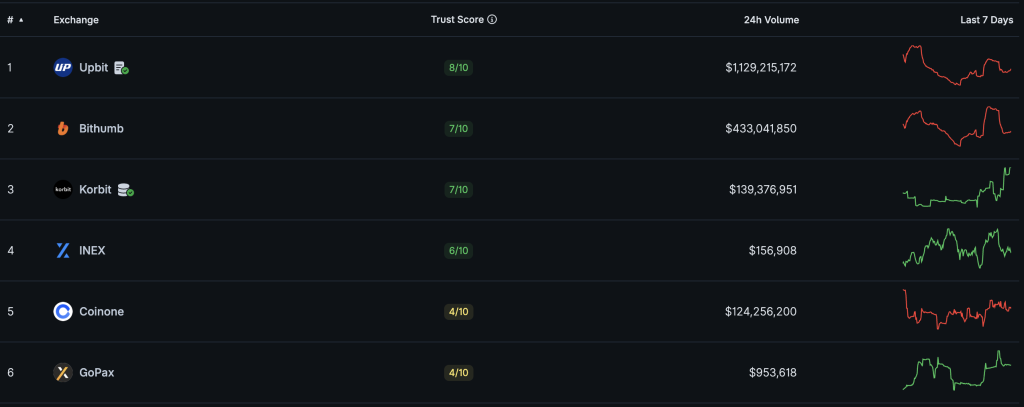
Domestic giants like Upbit and Bithumb are legally restricted to spot trading. In a volatile market, this restriction renders them obsolete for sophisticated traders looking to hedge downside risk or speculate with leverage.
This is not a sell-off. It is an arbitrage migration. A joint report by CoinGecko and Tiger Research estimates that 57% of the total outflows flowed directly to Binance.
South Korean traders now account for approximately 13% of Binance’s futures volume. The net result is a massive transfer of fees abroad; foreign exchanges earned an estimated 2.7 times more revenue from Korean users than domestic platforms did in 2025.
The disparity has crushed local profitability. Despite a 31% rise in deposits to 8.1 trillion won ($5.4 billion), operating profits for South Korea’s 18 exchanges collapsed by 38% to 380.7 billion won ($253.4 million). The volume is there, but the high-value transactional velocity has moved elsewhere. We are seeing similar liquidity demands globally; EDX Markets launching KRW perpetual futures suggests institutional players are already positioning to capture this volume offshore if domestic regulations don’t adapt.
The FSC report explicitly linked the outflows to “arbitrage and other similar activities,” a tacit admission that the current regulatory framework is bleeding value.
Regulatory News: The Policy Gap
The decision to delay the tax is an emergency brake, not a solution. The opposition Democratic Party, previously adamant about implementing the tax in 2025, capitulated after realizing the Capital Flight could permanently cripple the domestic fintech sector.
With 11.1 million crypto accounts in the country, representing over 20% of the population, the political cost of taxing a shrinking market became untenable.
The post Regulatory Backlash: $110B in Outflows Forces South Korea to Rethink Crypto Tax appeared first on Cryptonews.